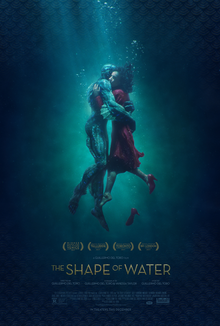
Director Guillermo del Toro takes a similar philosophy in a different direction in The Shape of Water (2017), which he co-wrote with Vanessa Taylor. His heroine, the mute Elisa (Sally Hawkins), and his slimy creature, referred to as the Asset (Doug Jones, naturally), indeed go all the way, a couple of times, but it's played as sweet and romantic instead of disgusting and creepy.
You may be wondering how a human woman and a mutant fish-man can engage in coitus. Don't worry. Elisa helpfully explains the process, through sign language and other hand gestures, to her best friend and co-worker Zelda (Octavia Spencer), in a conversation that runs the gamut from stunned incredulity to curiosity to unwavering support. We should all have friends as cool and understanding as Zelda.
Del Toro said in interviews The Creature from the Black Lagoon was a childhood favorite of his, but he was always saddened that the creature and the girl did not end up together. The Shape of Water was his way fixing that problem.
Despite the presence of a slimy, scaly inhuman "monster," The Shape of Water is not a horror movie. There aren't scares in the sense of a boogeyman leaping out of the shadows, although a nasty government agent played by Michael Shannon gives us a truly monstrous human villain, and there moments of violence that will make audiences squirm.
No, The Shape of Water is a tender love story about outsiders who find happiness with each other. If Superman made you believe a man could fly, The Shape of Water will make you believe a woman and an amphibious humanoid can fall in love.
The movie takes place during the 1950s. The Cold War is a hot topic. Elisa works as a custodian at a government facility where the Asset is kept and tortured. That's where they meet and bond, and it's sweet. She never demonstrates fear, only curiosity, and her muteness gives her an advantage over the scientists. She's used to communicating nonverbally, and she treats the creature with kindness.
Her relationship with the Asset receives support, not only from Zelda, who also works at the facility, but also her neighbor Giles (Richard Jenkins), a gay advertisement artist struggling to find work because would-be employers don't like his sexual orientation. In the 1950s, a mute woman, a black woman, and a gay man would all be regarded as second-class citizens. In The Shape of Water, they form a genuine bond, a found family that comes together to protect a creature that's even more of an outcast than them.
They receive unexpected assistance from a surprising source: Dr. Robert Hofstettler (Michael Stuhlbarg), a scientist who is really a Soviet spy named Dimitri. He may be a dedicated Communist, but he's first and foremost a scientist, and he, too, is amazed and awed by this magnificent being and what it could mean.
Had this movie been made in the 1950s, no doubt Dimitri would have been a villain, and Elisa would have ended up with the squared-jawed Colonel Strickland (Shannon), the guy who captured the Asset in South America. Strickland has the markings of a successful American of the period: wife, two kids, nice home, new car (that leads to a priceless moment during the escape attempt), and he looks good in a business suit.
Yet, he's a creep, sexually harassing Elisa because he likes silent women, and he's an ungrateful douchebag to boot; early on, the Asset bites his fingers off. Elisa and Zelda find them and place them in a lunch bag; he complains they got mustard on his digits. Over the course of the film, he only grows increasingly deranged and threatening.
The Shape of Water covers a lot of ground. It's romantic, dramatic, funny, and thrilling. It's also something of a love letter to cinema and not just because the premise borrows from Creature from the Black Lagoon. Elisa lives above a movie theatre, which attracts the interest of the Asset. At a key emotional moment, Elisa, faced with being separated from her love forever, imagines being able to sing to and dance with him, and the scene adopts a black-and-white visual scheme that mimics one of those classic Hollywood moments.
I know some folks have complained about that scene because it feels kind of random and cornball, but as a visualization of her longing, it's beautiful. Del Toro could have just shown her sitting at the table with a sad look on her face, or he could have done what he did: romanticize the moment, illustrate the joy she feels with him, and capture the impending heartbreak.
It's an unexpected touch in a movie comprised of moments that catch you off guard with charm. I don't watch a del Toro movie for the expected. His work is modern fantasy, and why shouldn't his characters be allowed to indulge occasionally when the world around them is so dark and threatening?


No comments:
Post a Comment